
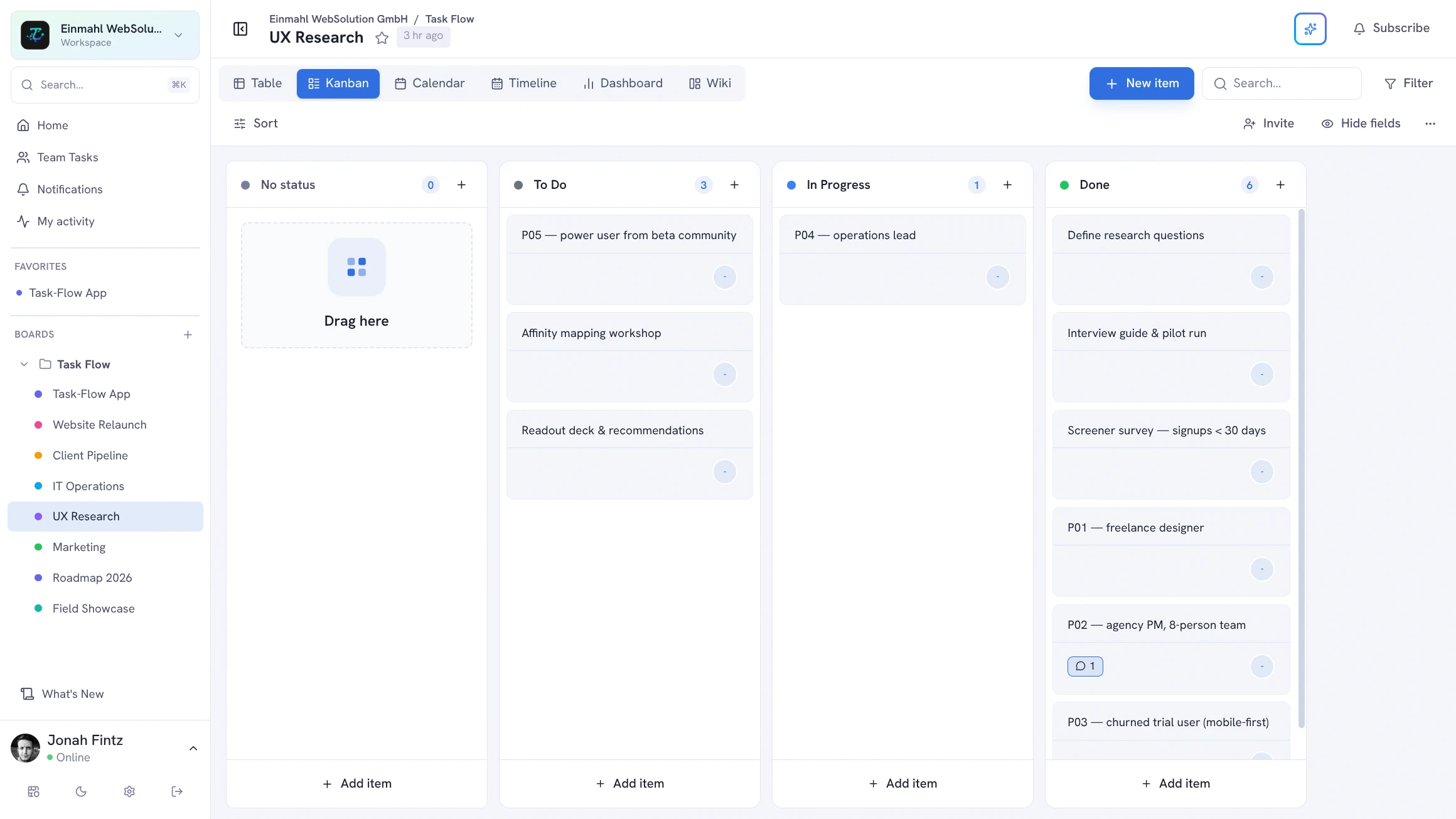
Research doesn’t fit into generic sprints. TskVlo’s flexible structure lets research teams build boards that reflect how experiments actually work — with the metadata fields, document attachments, and custom states that scientific work demands.
Custom Metadata for Research
Design boards with fields that match your research domain:
For a lab research board:
- TYPE (Status): Literature Review, Experiment, Analysis, Writing, Presentation
- HYPOTHESIS (Text): The experiment’s central hypothesis
- PHASE (Status): Planning → Active → Data Collection → Analysis → Written Up → Published
- EXPERIMENTER (Person): Lead researcher
- START DATE / END DATE (Date Range): Experiment duration
- SIGNIFICANCE (Number): p-value or effect size
- PUBLICATION (URL): Link to the published paper or preprint
Document and Dataset Attachments
Attach raw data files, experimental protocols, literature PDFs, or analysis scripts directly to task items. Up to 50 MB per file, stored securely. No more “which version of the protocol was used for Run 7?” — attach it directly to the task.
Rich Experimental Notes
Item descriptions support full Markdown. Write detailed experimental logs with headers, bullet points, tables, code blocks (for analysis scripts), and inline formatting. Descriptions are sanitized and rendered safely.
Cross-Disciplinary Collaboration
Use workspace roles to collaborate across departments or with external partners:
- Collaborators get Member access to contribute and comment
- Advisory committee members get Viewer access for oversight
- External reviewers join as Viewers restricted to selected boards (Workspace settings → Members & roles → Board Access → Restrict Access) — they see only those boards, nothing else in the workspace
All role assignments are per-workspace — give different people different levels of access without compromising other projects.
Data Privacy by Design
Research often involves sensitive data — patient records, proprietary methods, pre-publication findings. TskVlo processes your data in full compliance with GDPR, supports two-factor authentication, and keeps a full audit trail of every change. Workspaces are fully isolated from each other, so collaborations with different institutions stay cleanly separated.
Literature and Reference Tracking
Use a dedicated “Literature” board with fields for:
- Authors, year, journal (Text/Number fields)
- DOI / URL (URL field)
- Relevance rating (Rating field)
- Notes (Text field)
- Tags (Tags field): methodology, topic area, key references
Reference literature items from your experiment items — for example in the description or a comment — to build a traceable chain from evidence to hypothesis to experiment.